

Do you often experience dizziness and vertigo? Or dizzy from waking up first thing in the morning? Dizziness and vertigo are very common balance disorders that one might not think much about, but they are often confused with the overlapping symptoms of two conditions: Benign Paroxysmal Positional Vertigo (BPPV) and Cervicogenic Dizziness (also known as Cervical Vertigo).
Living in a fast-paced environment like Hong Kong, many people dismiss these episodes as simple fatigue or stress. However, when the world starts spinning the moment you sit up in bed, or if you feel a persistent “floating” sensation after hours of working at a desk, your body is likely signaling a mechanical issue. Whether it’s a problem with the delicate crystals in your inner ear or the sensory receptors in your neck, understanding the “why” behind your dizziness is the first step toward reclaiming your balance.
In this blog post, we will touch base on what these conditions are, provide 6 detailed exercises to help with your symptoms, and explain how professional physiotherapy can provide a lasting solution.
Table Of Content
1. The Room is Spinning: What is BPPV?
BPPV (Benign Paroxysmal Positional Vertigo) is a prevalent vestibular disorder mainly characterized by brief episodes of intense vertigo triggered by specific head movements.
The Science: Why do "Ear Crystals" Move?
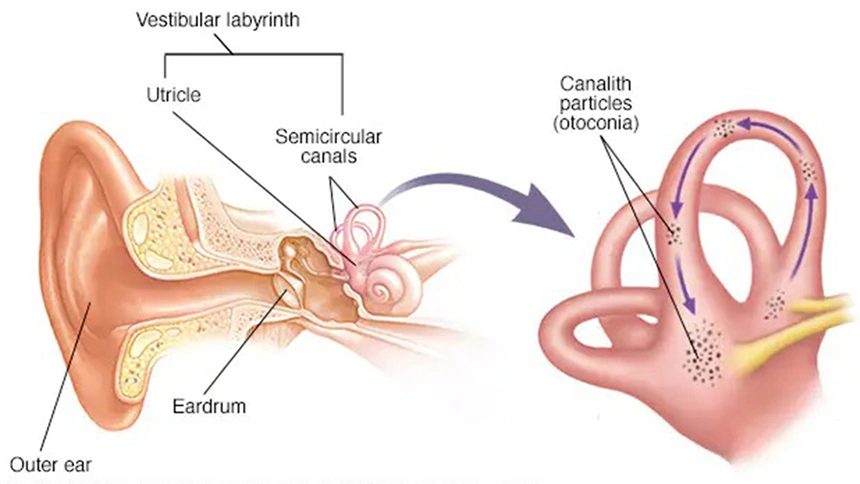
Inside our inner ear, the utricle contains tiny calcium carbonate crystals (otoconia) that help us sense gravity. Due to aging, head trauma, or even prolonged side-sleeping, these crystals can become dislodged and fall into the semicircular canals. When you move your head, these floating crystals shift the fluid in your ear, sending a false signal to the brain that you are spinning rapidly.
Typical Symptoms of BPPV:
- Brief, Intense Vertigo: The sensation usually lasts 30 seconds to 1 minute.
- Triggered by Position: Triggered by rolling over in bed, sitting up, or tilting the head back.
- Nausea: Often accompanied by a feeling of motion sickness.
Traditional Diagnosis and Treatment
Physiotherapists use the Dix-Hallpike Test as the “gold standard” for diagnosis. We guide your head into specific positions to observe Nystagmus (involuntary eye twitching). Once diagnosed, we perform Canalith Repositioning Maneuvers (like the Epley Maneuver) to move the crystals back to where they belong. Usually, 1–2 sessions provide significant relief.
2. The Invisible Disruptor: What is Cervicogenic Dizziness?
Cervicogenic Dizziness (Cervical Vertigo) is a sensation of imbalance that arises from issues in the cervical spine, often related to neck pain or stiffness.
Your brain relies on signals from your eyes, inner ear, and the proprioceptors (position sensors) in your neck. In Hong Kong, “text-neck” and poor office ergonomics lead to chronic neck tightness. When these neck sensors send distorted signals, it creates a mismatch with your visual and ear inputs, resulting in a “drunken” or “swaying” feeling.
- Vague Imbalance: A feeling of being “spaced out” or lightheaded.
- Neck Pain: Almost always accompanied by stiffness or pain in the upper neck.
- Fluctuating Duration: Can last minutes to hours, often worsening with neck movement.
6 Exercises to Help You
Physiotherapy uses Vestibular Rehabilitation Therapy (VRT) to retrain your brain. Here are six exercises detailed to help you recover:
A. Visual & Ocular Coordination
- Smooth Pursuit Training This exercise focuses on improving the coordination between your eyes and your brain. To perform this, hold a pen at arm’s length. Keep your head perfectly still and follow the tip of the pen with only your eyes as you move it slowly in an ‘H’ pattern (far left to far right, then up and down). Ensure you keep the tip in sharp focus throughout. If your vision blurs or your eyes “jump,” slow down. This retrains the ocular muscles to track movement without triggering dizziness.
- Gaze Stability (VOR x1 Training) The Vestibular-Ocular Reflex (VOR) allows you to stay focused on a target while your head is moving. Stick a small letter ‘A’ on a wall at eye level. Stare at the letter and rotate your head side-to-side in a small arc (about 20 degrees). Start slowly and increase speed as long as the letter stays clear. If it blurs, you’ve reached your limit. This exercise “resets” the coordination between your inner ear and your eyes, which is vital for preventing dizziness while walking.
B. Cervical Stability & Posture Correction
- Deep Neck Flexor Activation (The Chin Tuck) Cervical vertigo is often tied to weakness in the deep muscles of the neck. Sit or stand with your back against a wall. Without tilting your head up or down, pull your chin straight back as if making a “double chin,” trying to touch the back of your neck to the wall. You should feel a gentle stretch at the base of your skull. Hold for 5 seconds and repeat 10 times. This strengthens the stabilizers that prevent the “swaying” sensation caused by neck fatigue.
- Scapular Stabilization (Y-to-W Stretch) Slouching puts immense pressure on the nerves at the base of the skull. Stand against a wall and raise your arms into a “Y” shape. Slowly slide your elbows down toward your waist to form a “W,” squeezing your shoulder blades together. Keep your lower back flat against the wall. This opens up the chest and reduces the mechanical strain on the upper neck that often contributes to dizzy spells after long hours at a computer.
C. Rebuilding Balance & Proprioception
- Romberg Stance (Sensory Integration) This exercise teaches your brain to rely on your joints rather than just your vision. Stand in a corner for safety, feet touching side-by-side, and arms crossed over your chest. Hold for 30 seconds with eyes open. Once stable, try it with your eyes closed. Without visual input, your brain must use your neck and ankles to stay upright. If you sway significantly, it’s a sign that your proprioceptive system needs this specific training to handle real-world balance challenges.
- Tandem Gait (Tightrope Walk) Walking “off-balance” is a major fear for vertigo sufferers. Find a straight line on the floor. Walk slowly, placing the heel of your front foot directly against the toes of your back foot—like walking a tightrope. Keep your chest up and look forward, not at your feet. This narrow base of support challenges the vestibular system to maintain a vertical center, helping to eliminate that “drunken” feeling during your daily commute.
Why Professional Physiotherapy is Essential
Searching for “Epley Maneuver” on YouTube is risky. If you have crystals in the wrong canal or have a neck vascular issue, DIY maneuvers can cause severe vomiting or even injury.
Physiotherapy offers:
- Accurate Diagnosis: Identifying if the cause is the ear, the neck, or both.
- Professional Maneuvers: Precise repositioning that typically resolves BPPV in 1–3 sessions.
Manual Therapy: Releasing the deep neck tension that drives cervicogenic dizziness.
Conclusion
Dizziness is more than just a physical sensation; it is an emotional burden that can make you feel disconnected from your own body and fearful of simple daily movements. Whether it is the sharp, spinning intensity of BPPV or the persistent, “spaced-out” feeling of Cervicogenic Dizziness, you don’t have to “just live with it.”
While the exercises provided above are excellent tools for maintenance and recovery, they are most effective when part of a structured, professionally guided plan. In a city as fast-paced as Hong Kong, your vestibular and cervical health are the foundations of your productivity and well-being.
At Mobilize Physio, we specialize in “untangling” these complex symptoms. We don’t just treat the dizziness; we treat the person. By combining precise vestibular diagnostics with expert manual therapy for the neck, we help you transition from feeling “off-balance” to feeling empowered and steady on your feet.



Physiotherapy Service
Mobilize Physio is a physiotherapy center located in Hong Kong. Our team of professional physiotherapists provides high-quality, evidence-based pain treatment. Our services include sports injury treatment, pain management, post-surgery rehabilitation, and posture and body alignment correction.
Every patient is unique, and we believe that every treatment plan should be customized accordingly. Therefore, we focus on one-on-one service to ensure that each patient receives personalized attention and specialized care. Contact us today to learn more about our physiotherapy services.
Latest Blog Posts

5 Exercises to Strengthen Your Hidden Core | The Gold Standard: Why Physiotherapy is the First Line of Defence for Women’s Pelvic Health

Say Goodbye to the “Slouch”: A Guide to Understanding and Fixing Rounded Shoulders
The Road to Recovery: Understanding Whiplash and Early Intervention
The Science of Precision Recovery: How Force Plate Technology is Transforming Physiotherapy

Waking Up Dizzy? Understanding BPPV vs. Cervicogenic Dizziness: A Comprehensive Guide to Diagnosis and Recovery

How to Heal a Sprained Ankle: 4 Best Rehab Exercises to Prevent Re-injury