
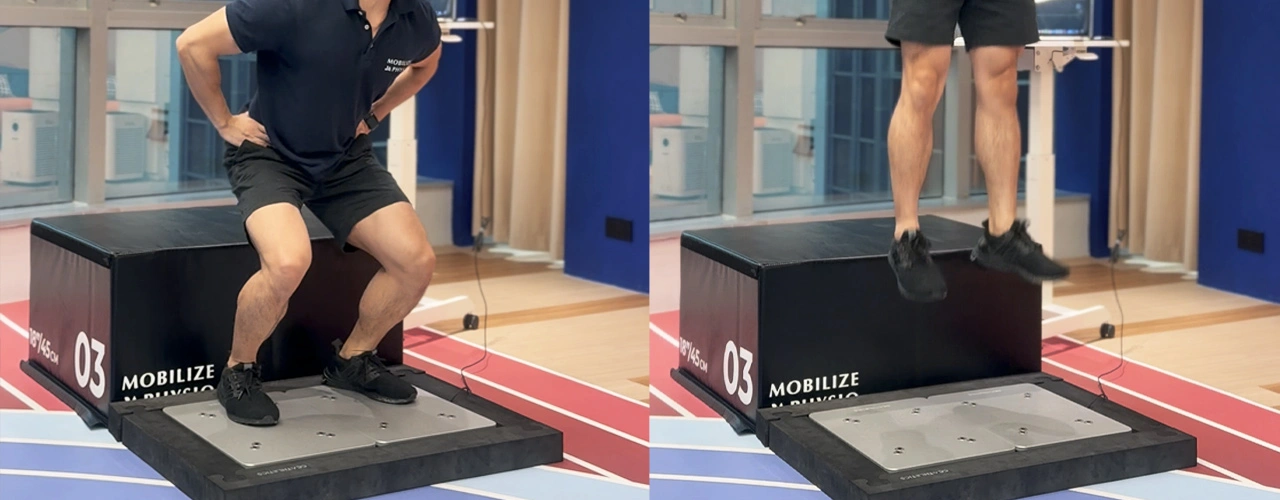
In the past, assessing movement in a clinical setting relied heavily on a physiotherapist’s expert eye and manual muscle testing. While clinical intuition remains invaluable, the human eye is limited by its “sampling rate”, it simply cannot catch what happens in the millisecond a foot hits the ground.
At Mobilize Physio, we believe that if you aren’t measuring, you are guessing. That is why we utilize Force Plate technology to bring elite-level sports science into your rehabilitation journey. This blog explores the physics behind the plates and how they provide the roadmap for your recovery.
Table Of Content
What is a Force Plate?
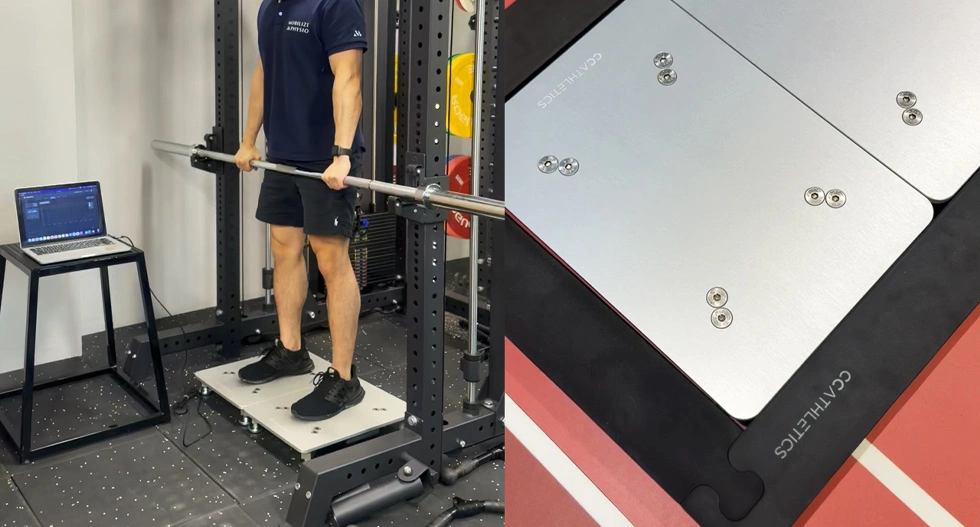
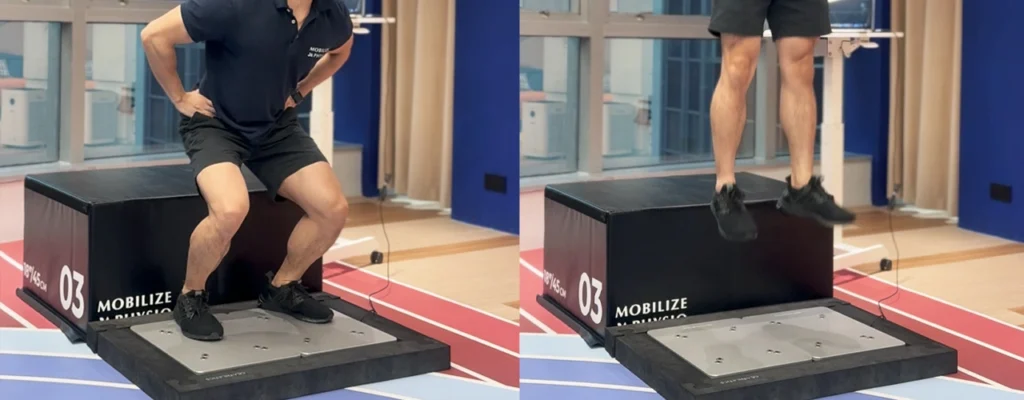
At first glance, a force plate looks like a heavy-duty scale. However, unlike a bathroom scale that only measures static weight, a force plate is a sophisticated biomechanical sensor designed to measure Ground Reaction Force (GRF)—the force exerted by the ground on a body in contact with it.
The Engineering Inside
Force plates are typically equipped with one of two types of sensors: strain gauges or piezoelectric sensors.
- Strain Gauges: These are housed within the platform’s load cells. When you step on the plate, the metal structure undergoes a microscopic deformation (stress). The sensors measure this stress, which is directly proportional to the force applied.
- The Physics of Movement: At rest, the GRF represents your body weight. However, when you move, the GRF changes according to Sir Isaac Newton’s Second Law (F=ma). To accelerate your body upward or forward, you must apply force into the plate; the plate measures exactly how much “push” you are giving the world.
Force is measured in Newtons (N). To put this in perspective, 1N is the force required to accelerate a 1kg mass at a rate of 1m/s^2. In a high-impact jump, a person can easily exert forces exceeding 3,000 Newtons in a fraction of a second.
The Power of the Force-Time Curve
The most significant advantage of a force plate is its ability to produce a Force-Time Curve. This is a visual graph that plots force production over the duration of a movement.
The Force-Time Curve is not just a line; it is a chronological narrative of how your body handles load. When we analyze a Countermovement Jump (CMJ), we break the curve into three distinct phases:
1. The Eccentric (Braking) Phase
As you squat down to prepare for a jump, your muscles act like brakes. The curve shows us how efficiently you “load the spring.”
- Clinical Significance: Many patients with chronic tendon issues (like Patellar Tendonitis) or those recovering from surgery have a “shallow” braking curve. They are afraid to load the limb, so they decelerate slowly. This identifies a lack of confidence or eccentric strength that a standard weight-lifting session might miss.
2. The Amortization (Transition) Phase
This is the split second between moving down and exploding up. It tests your Stretch-Shortening Cycle (SSC).
- Clinical Significance: A long, flat transition phase suggests a “leak” in your energy transfer. We use this data to determine if we need to implement plyometric training to help your tendons and nervous system become more reactive.
3. The Concentric (Propulsive) Phase
This is the “launch” phase where you push off the ground.
- Clinical Significance: By using two plates (one under each foot), we see the Dual-Force Curve. We can see if your left leg is doing 60% of the work while your right leg does 40%. Even if the jump looks symmetrical to the eye, the curve reveals the “hidden” compensation.
Instead of just knowing how high you jumped, we can see how you produced that jump. We can analyze:
- The Braking Phase: How well you absorb force as you dip down.
- The Propulsive Phase: How quickly you can generate power to leave the ground.
- Landing Mechanics: How your body manages the impact when returning to earth.
A Deeper Look: What Exactly Does the Plate Measure?
While we measure “force,” that force is broken down into specific metrics that tell us about different qualities of your muscle and nervous system function:
- Peak Force (Maximal Strength): This is the highest point on the graph. It represents the maximum amount of force your muscles can produce. It is the “engine size” of your body.
- Rate of Force Development (RFD / Explosiveness): This is perhaps the most critical metric for injury prevention. It measures how fast you can develop force. In a real-world scenario—like tripping on a curb or pivoting in football—it doesn’t matter how strong you are if you can’t “turn on” that strength in the first 50 to 150 milliseconds.
- Impulse: This is the “area under the curve.” It represents the total amount of force applied over a specific period. In jumping, a higher impulse generally leads to a higher jump.
- Dynamic Strength Index (DSI): By comparing your peak force in a static test (like a mid-thigh pull) to a dynamic test (like a jump), we can see if you need to focus more on getting stronger or getting faster.
Force plates provide real-time data on several critical physical attributes:
We can identify subtle imbalances between your left and right sides. Many patients “favor” a limb after an injury without even realizing it. The plates reveal these asymmetries in real-time, allowing us to correct your weight distribution before it leads to secondary compensations.
Using tests like Countermovement Jumps (CMJ), Multi-Rebound Jumps, and Drop Jumps, we measure how effectively your muscles and tendons act like springs. This is vital for anyone from a casual hiker to a competitive basketball player.
By measuring the movement of your Center of Pressure (CoP) while standing, we can quantify your balance and neurological stability. This is particularly useful for vestibular rehab or elderly patients focusing on fall prevention.
How Physiotherapy Utilizes Force Plate Data: A Deeper Dive
In a modern clinical setting, force plates act as a “biometric microscope.” They allow us to move beyond what we think we see to what is actually happening at a neuromuscular level. Here is a detailed breakdown of how we apply this data across different patient populations.
1. Post-Surgical & Injury Rehabilitation: The "Gold Standard" for ACL Recovery
The most dangerous phase of an ACL or meniscus recovery is the transition from “feeling good” to “playing hard.” Traditionally, therapists used the Limb Symmetry Index (LSI) via a tape measure—if you hopped 1.5 meters on your good leg and 1.4 meters on your surgical leg, you were cleared.
The Problem with "The Tape Measure":
The human body is a master of deception. A patient can achieve a long hop distance by using a “hip-dominant” strategy (swinging the trunk and using the glutes) to bypass a weak knee. This protects the knee in the clinic but leaves it vulnerable on the field.
How Force Plates "Catch the Cheat":
- Eccentric Deceleration:
We look at the Braking Phase of the hop. If the surgical leg shows a “flat” force curve compared to the healthy leg, it means the patient is hesitant to load the knee joint. This lack of “eccentric braking” is a leading predictor of future ACL graft failure. - Time to Takeoff:
Force plates measure how long it takes you to generate force. If your surgical leg takes 200ms longer to produce the same power as the healthy leg, you aren’t ready for the reactive nature of sports like basketball or football.
2. Running and Endurance Athletes: Decoding the "Impact Transient"
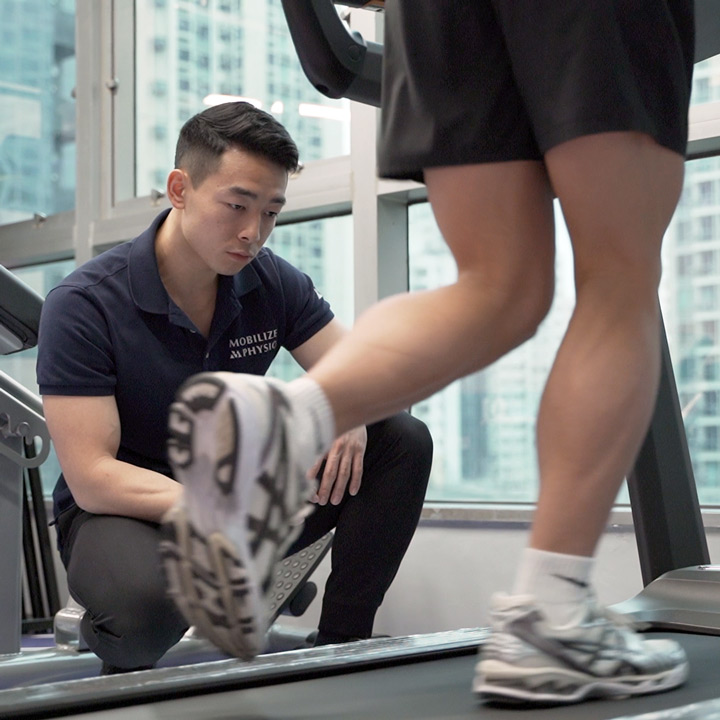
For runners, every step is a collision with the earth. Over a 10km run, you might hit the ground 8,000 times. Force plates help us analyze the Internal Loading that a video camera simply cannot see.
- Impact Transient & Loading Rate:
When your heel or midfoot strikes the plate, we see a sharp spike in force called the “Impact Transient.” If the slope of this line is too vertical (a high Vertical Average Loading Rate), it means your body is absorbing force too quickly. This “shock” is often the root cause of stress fractures, shin splints, and plantar fasciitis. - Gait Retraining with Real-Time Data:
We can have you run or march on the plates and provide biofeedback. If the data shows you are “heavy-footed,” we can work on increasing your cadence or shifting your strike pattern, watching the force numbers drop in real-time until we find your “mechanical sweet spot.” - Footwear Validation:
Not every “super shoe” or orthotic is right for every runner. We can objectively test how different footwear affects your force distribution and propulsion, ensuring your gear is actually protecting you.
3. Return to Sport (RTS) & Athletic Readiness
“Clearing” an athlete for sport is a heavy responsibility. Force plates move this decision from a subjective opinion to a data-driven “Go/No-Go” checklist.
- Identifying “Quiet” Deficits:
An athlete might have 100% muscle strength in a static gym machine but only 70% Reactive Strength Index (RSI) on the force plate. RSI measures how quickly you can transition from landing to jumping. If this is low, your “stiffness” is compromised, increasing the risk of non-contact injuries. - Testing Under Fatigue:
Injuries rarely happen in the first 5 minutes of a game; they happen in the last 5. We use force plates to test athletes in a fatigued state. If your symmetry drops from 95% to 75% after a conditioning circuit, it tells us your neuromuscular control “breaks down” when tired—a critical insight for your coaching team.
4. Tracking Progress: From Baseline to Breakthrough
The journey from injury to performance is rarely a straight line. Force plate data provides the “GPS” for this journey.
- The Baseline (Day 1): We establish your “starting signature.” This removes the frustration of not knowing if you are improving.
- The Rehabilitation Phase: Every 4 weeks, we re-test. If your Peak Power is increasing but your Braking Impulse is stagnant, we pivot your program to focus more on eccentric loading.
- Testing Daily Activities: For non-athletes, we use the plates to assess Sit-to-Stand power and Balance Sway. This is vital for ensuring that a grandparent has the leg power to stand up safely from a chair or recover their balance after a slip.
Conclusion
In an era where technology defines the future of healthcare, the integration of Force Plate technology marks a shift from reactive care to proactive, data-driven recovery. We provide our patients with more than just a treatment plan; we provide them with a roadmap to peak performance.
Whether you are navigating the complexities of ACL rehabilitation, seeking to optimize your running gait, or simply aiming to maintain balance and stability in your daily life, the precision of our assessment tools ensures that every step of your journey is backed by science. At Mobilize Physio, we eliminate the guesswork, identifying hidden deficits and validating your progress with real-time data so you can return to the activities you love with absolute confidence.


Physiotherapy Service
Mobilize Physio is a physiotherapy center located in Hong Kong. Our team of professional physiotherapists provides high-quality, evidence-based pain treatment. Our services include sports injury treatment, pain management, post-surgery rehabilitation, and posture and body alignment correction.
Every patient is unique, and we believe that every treatment plan should be customized accordingly. Therefore, we focus on one-on-one service to ensure that each patient receives personalized attention and specialized care. Contact us today to learn more about our physiotherapy services.
Latest Blog Posts

5 Exercises to Strengthen Your Hidden Core | The Gold Standard: Why Physiotherapy is the First Line of Defence for Women’s Pelvic Health

Say Goodbye to the “Slouch”: A Guide to Understanding and Fixing Rounded Shoulders

The Road to Recovery: Understanding Whiplash and Early Intervention
The Science of Precision Recovery: How Force Plate Technology is Transforming Physiotherapy

Waking Up Dizzy? Understanding BPPV vs. Cervicogenic Dizziness: A Comprehensive Guide to Diagnosis and Recovery

How to Heal a Sprained Ankle: 4 Best Rehab Exercises to Prevent Re-injury