MOBILIZE 物理治療中心

Common Conditions

Knee Pain

Knee Pain Treatment: From Self-Assessment to Physiotherapy

Knee Pain: Diagnosis to Recovery

Knee pain has many possible causes and is not always due to “degeneration.” At Mobilize Physio, we use clinical differential diagnosis to help identify the true source of your pain. Based on medical guidelines, this page explains how knee pain can be initially screened according to pain location and symptom patterns.

Is Knee Pain Always a Knee Problem? (Referred Pain)

Pain may originate from the lumbar spine or hip joint (referred pain). In some cases, the knee is only the “victim,” while the true source of the problem lies in the lower back or hip. This phenomenon is known as referred pain.

  • Lumbar Spine Nerve Compression: The nerves responsible for sensation in the lower limb originate from the lumbar spine, particularly the L3–L4 segments. If a disc herniation compresses these nerves, pain may travel like an electric shock from the thigh down to the knee. This type of pain is often accompanied by numbness or weakness in the leg.

  • Hip Joint Stiffness: The hip and knee joints are connected by the same femur. When hip mobility is restricted (for example, difficulty rotating the hip), the knee is forced to tolerate extra rotational stress during walking or sports, which can lead to pain.

Professional Tip: If your knee pain is accompanied by pain when bending forward, or if your hip feels “stuck” when putting on socks, it is recommended to assess the lumbar spine and hip joint first.

How to Initially Identify Knee Pain Based on Pain Location

Doctors and physiotherapists often use pain location as a key factor in preliminary differential diagnosis. You can compare your symptoms with the categories below:

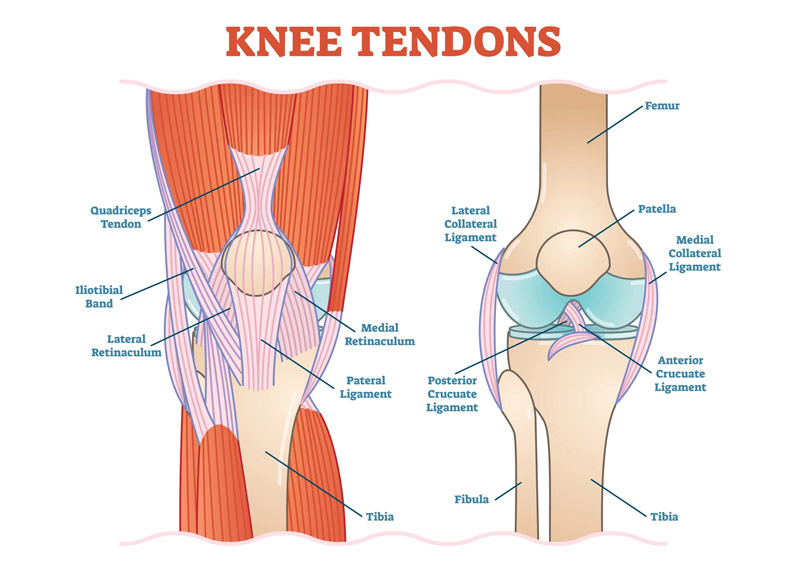
  • Front of the Knee (Anterior):

    • Sensation: Pain when going up or down stairs, or aching at the front of the knee after prolonged sitting.

    • Common Causes: Patellofemoral Pain Syndrome (PFPS), also known as Runner’s Knee, usually due to abnormal patellar tracking.

  • Below the Kneecap (Inferior):
    • Sensation: A sharp, pinpoint pain, most noticeable during jumping or deep squatting.
    • Common Causes: Patellar Tendinitis (Jumper’s Knee).
  • Outer Side of the Knee (Lateral):
    • Sensation: A tight or stabbing pain on the outside of the knee after running for a period of time.
    • Common Causes: Iliotibial Band (ITB) Syndrome.
  • Inner Side / Joint Line (Medial / Joint Line):
    • Sensation: Pain when pressing along the joint line, or a feeling that the knee is “catching” or “locking.”
    • Common Causes: Meniscus Tear or Knee Osteoarthritis (OA).
Which Type of Knee Pain Do You Have?

Scenario A: Post-Exercise Pain

  • Symptoms: Stinging pain on the outside of the knee during or after running or cycling.
  • Common Cause: Iliotibial Band (IT Band) Syndrome
  • Recommendation: This is common among long-distance runners and is often related to insufficient hip muscle control.

👉 Learn more: IT Band Syndrome Treatment and Exercises

Scenario B: Sharp Pain Below the Kneecap

  • Symptoms: A distinct sharp pain below the kneecap during jumping, squatting, or walking downstairs.
  • Common Cause: Patellar Tendinitis (Jumper’s Knee)
  • Recommendation: Common in basketball and volleyball players, and often requires targeted eccentric loading exercises.

👉 Learn more: Jumper’s Knee Treatment Options

Scenario C: Dull Ache Behind the Kneecap

  • Symptoms: Knee soreness after prolonged sitting (e.g. watching a movie or on a flight); pain is worse going downstairs than upstairs.
  • Common Cause: Patellofemoral Pain Syndrome (PFPS / Runner’s Knee)
  • Recommendation: A classic presentation of runner’s knee, usually related to poor patellar tracking.

👉 Learn more: Causes and Treatment of Runner’s Knee

Other Possible Causes of Knee Pain

Acute Injury

  • Hearing a “pop” sound followed by rapid swelling, heat, and pain may indicate an anterior cruciate ligament (ACL) or meniscus tear. Immediate physiotherapy assessment is recommended to prevent further damage.

👉 Learn more: ACL / PCL Injury Treatment

👉 Learn more: Meniscus Tear Treatment

Osteoarthritis

  • Morning stiffness that improves with movement, or aching pain during weather changes. Physiotherapy can effectively reduce joint stress by strengthening surrounding muscles and help delay the need for joint replacement.

Physiotherapy vs Surgery

According to international clinical guidelines, most non-acute knee pain should first be managed with conservative treatment (physiotherapy) before considering surgery. The majority of knee pain conditions, including mild meniscus tears, tendinopathies, and degenerative changes, can recover with non-surgical management. At Mobilize, our treatment focus includes:

  • Pain and inflammation management: Ultrasound therapy, acupuncture, and other modalities

  • Biomechanical correction: Addressing flat feet or knee valgus (knee collapse)

  • Strength training: Strengthening the gluteus medius and quadriceps to create a “natural brace” for the knee

Common Questions About Knee Pain

Not necessarily. The knee is sometimes the “victim,” while the true source of pain may come from the lumbar spine or hip joint, a phenomenon known as referred pain. For example, nerve compression in the lumbar spine (such as sciatica) can radiate pain into the thigh and knee, while hip stiffness can increase rotational stress on the knee. If your knee pain is accompanied by lower back pain or leg numbness, spinal assessment is recommended.

Sudden, non-traumatic knee pain commonly has three main causes:

  • Gout: Accumulation of uric acid crystals, characterized by redness, swelling, heat, and severe pain, often after alcohol intake or high-purine meals.

  • Meniscus Locking: Displaced fragments from a previous meniscus tear can block the joint, causing sudden inability to straighten the knee with sharp pain.

  • Infection: A hot, swollen knee accompanied by fever is a medical emergency and requires immediate medical attention.

This is often related to load management. A sudden increase in training volume may exceed the tendon’s capacity, leading to tendinopathy (such as jumper’s knee). In addition, hip muscle fatigue may alter running mechanics (knee valgus), increasing stress on ligaments during later stages of exercise.

Chronic knee pain lasting more than three months usually falls into two categories:

  • Younger individuals: Often due to biomechanical issues (e.g. flat feet, weak core muscles), leading to uneven knee loading and soft-tissue overuse injuries such as PFPS.

  • Middle-aged and older individuals: Commonly due to osteoarthritis, where cartilage wear reduces joint cushioning, often presenting with morning stiffness.

Unless there is an acute injury with significant swelling, heat, and pain, complete rest often leads to muscle weakness and slower recovery. At Mobilize, we promote optimal loading. Physiotherapists adjust training intensity and movement patterns to keep you active without worsening symptoms. For example, runner’s knee patients may temporarily reduce running volume while focusing on hip strengthening to improve running mechanics.

Pain when walking downstairs reflects increased load on the knee and is commonly seen in patellofemoral pain syndrome (PFPS). This is very common among young runners and office workers and is not necessarily irreversible “degeneration.” It is often caused by muscle imbalance around the thigh, leading to abnormal patellar tracking. With appropriate physiotherapy correction, symptoms often improve significantly.


👉 Learn more: Runner’s Knee Treatment

Testimonials & Reviews

After suffering years of chronic knee issues after ACL reconstructive surgery I was recommended to this clinic and the results were amazing. The centre does not only focus on pain relief but with an extremely holistic approach, assesses the root cause of pain and focuses on return to sports and performance once the pain diminishes. Most physiotherapy centres in Hong Kong do not even offer this level of attention to detail and service and would highly recommend to anyone having chronic pains or want to have proper post orthopaedic surgery rehabilitation!
Arnold Woo
⭐ ⭐ ⭐ ⭐ ⭐
I had never been a believer in physio therapy in the past or that my experience with multiple chain medical physiotherapy center had brought me nothing but temporary improvements. Until I had came across mobilize physiotherapy where they take the extra mile to examine your situation and tailor a physiotherapy session. The physiotherapists at Mobilize not only identifies the root cause and provide massages for pain relievers but also to provide take home exercises for improvements. I was never rush out the door for the next session and they ensure that I had receive the right treatment before the session ends.
I would highly recommend this physiotherapy center.
Edmond Chan
⭐ ⭐ ⭐ ⭐ ⭐
I came to them with chronic neck and knee issues, and they didn't just provide massage therapy. They took the time to thoroughly evaluate the source of my problems and develop a comprehensive treatment plan.
Through a combination of targeted hands-on therapy, customized strengthening exercises, and patient education, they helped me regain mobility and address the root causes of my pain. I learned the correct ways to strengthen the muscles and improve my posture to prevent future issues.
The staff is incredibly knowledgeable, taking the time to explain everything and ensure I understood how to continue my progress at home. Thanks to their expertise and dedication, I'm now pain-free and able to return to my regular activities without any limitations.
Arthur Liu
⭐ ⭐ ⭐ ⭐ ⭐
Avery at Mobilize Physio is a skilled and professional therapist. My knee issue has improved significantly, and sports performance has been enhanced as well. I recommend their services, particularly for sports lovers.
Teddy Wong
⭐ ⭐ ⭐ ⭐ ⭐
Physiotherapist Will is very knowledgeable and professional. I hurt my knee and shoulder, and the physiotherapy treatment include detailed assessment, muscle relax and exercise rehabilitation / strengthening and target my routine sport / exercise. The treatment is 1-on-1 which allow adequate time for interaction with patience of treatment and detailed explanation. The place is clean / tidy (with decent equipment for exercise rehabilitation / strengthening) and the staff are nice and helpful. The treatment give me confidence for recovery. Thank you so much Mobilize Physio!
Ricky Mak
⭐ ⭐ ⭐ ⭐ ⭐
I can't recommend my physio partner enough! They are always patient and provide valuable guidance to help me relieve chronic pain and improve my performance in jiu-jitsu. Their expertise has been invaluable to me. Highly recommended!
Felix Kung
⭐ ⭐ ⭐ ⭐ ⭐

Book an Appointment

Get in touch with our physiotherapists