
MOBILIZE 物理治療中心

Common Conditions

Dowager's Hump

Symptoms, Common Causes and Treatments

What is Dowager's Hump?

In medical terms, a "Dowager's Hump" is often referred to as a cervicothoracic fat pad or a posterior cervical hump. It is a protrusion located at the junction where the neck meets the upper back (specifically between the seventh cervical vertebra, C7, and the first thoracic vertebra, T1). While the colloquial Chinese name "Wealthy Bump" (富貴包) suggests a link to prosperity, it is actually unrelated to wealth—it is the cumulative result of long-term poor posture or specific health issues.

From an anatomical perspective, the formation of a Dowager's Hump primarily involves forward head posture and thoracic kyphosis (slouching). When the head remains in a forward-leaning position for extended periods, the muscles and fascia at the back of the neck must endure immense tension to support the head's weight. As a defense mechanism to protect this overstressed area, the body accumulates fatty and connective tissue, eventually forming a visible bulge. This not only affects appearance but can also compress surrounding nerves and blood vessels, leading to various discomforts.

Through proper physical therapy assessment and targeted intervention, most cases caused by poor posture can be significantly improved.

Types

Dowager’s Hump can generally be categorized into three types:

  • Fatty Type: Feels soft to the touch. It is primarily caused by local fat accumulation and is common in individuals who are overweight or lack regular exercise.
  • Myofascial Type: Feels firm. It is caused by long-term poor posture leading to muscle stiffness, fascial thickening, and inflammation in the neck and back.
  • Skeletal Type: Feels hard. This usually involves significant spinal deformation (such as severe forward head posture or increased kyphosis) and may even involve bone spurs (osteophytes).

Symptoms

Beyond the visible protrusion, patients often experience:

  • Neck and Shoulder Pain/Stiffness: The most common early symptom; patients often feel a heavy, tight sensation in the back of the neck and shoulders.
  • Headaches and Dizziness: Tight neck muscles can compress the occipital nerves or affect blood circulation to the head, leading to tension headaches or vertigo.
  • Arm Numbness or Weakness: If the hump is accompanied by severe cervical degeneration or a herniated disc, it may compress nerve roots, causing pain or numbness to radiate down the arms to the fingers.
  • Chest Tightness and Shallow Breathing: Severe slouching and a Dowager’s Hump can restrict chest expansion, affecting breathing depth and causing a feeling of “heaviness” in the chest.

Common Causes

The formation is usually a result of multiple factors:

  • Chronic Poor Posture: The leading cause. Modern habits like looking down at phones (“Tech Neck”) or leaning into a computer screen (“Turtle Neck”) alter the natural curve of the spine.
  • Lack of Exercise and Muscle Weakness: Weak core and back muscles (such as the trapezius and rhomboids) fail to support the spine, leading to slouching.
  • Hormonal Changes and Obesity: Excess weight leads to fat storage in the upper back. Additionally, certain endocrine disorders (like Cushing’s Syndrome) or long-term steroid use can cause abnormal fat distribution.
  • Osteoporosis and Spinal Degeneration: As we age, bone loss and disc degeneration can cause the spine to shift, increasing the risk of a hump.
How to Self-Test for Dowager's Hump

You can perform these two simple home tests to assess your spinal alignment and muscle tightness.

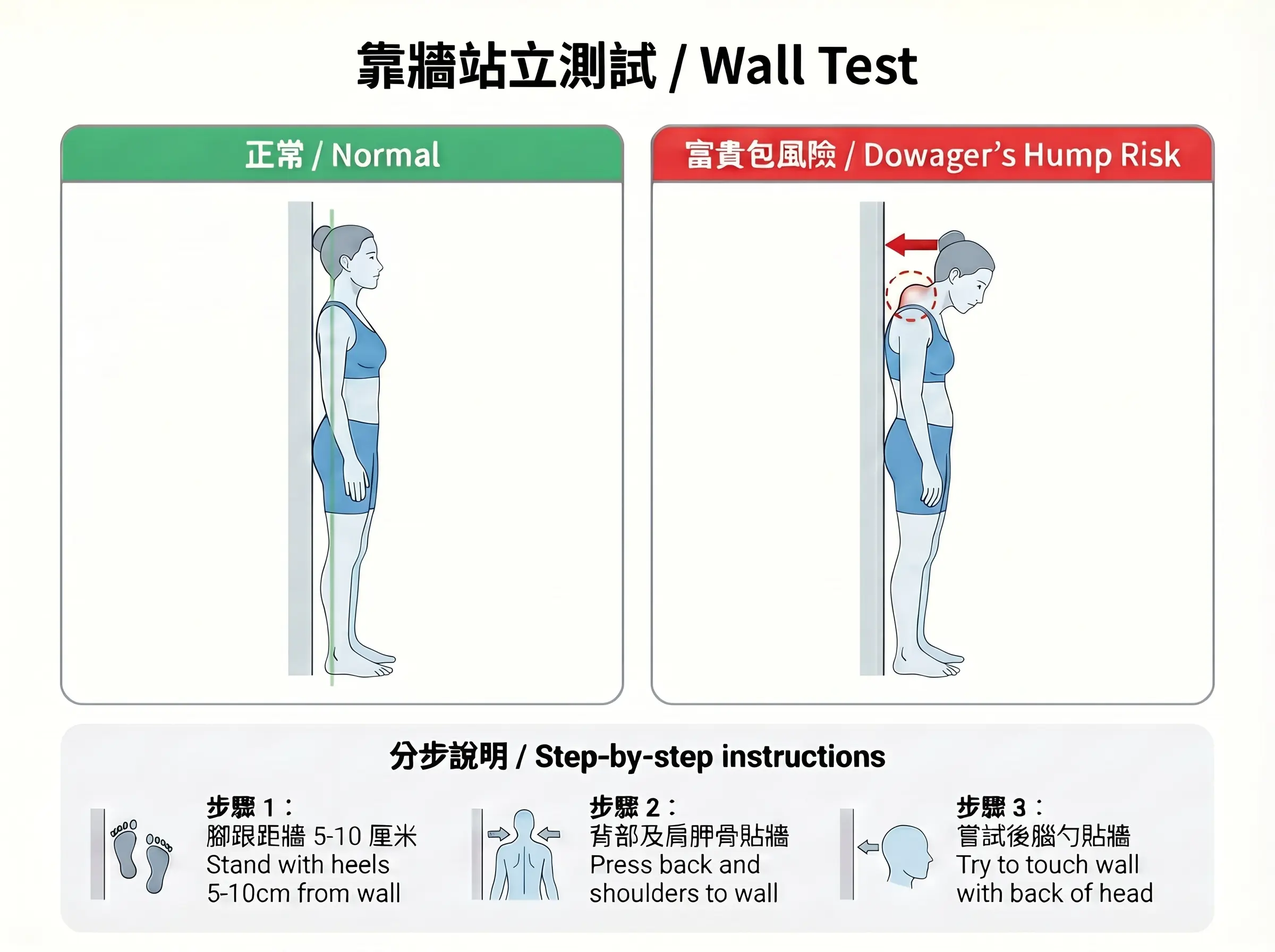
The Wall Test

A classic method to evaluate spinal alignment and forward head posture.

  1. Preparation: Stand with your back against a flat wall. Keep feet shoulder-width apart, with heels about 5–10 cm away from the wall.
  2. Position: Gently press your buttocks and shoulder blades against the wall.
  3. Observation: Looking straight ahead with your chin slightly tucked (don’t tilt your head up), try to touch the back of your head to the wall.

Result:

  • Normal: The back of your head touches the wall easily without strain.
  • Suspected Hump/Tech Neck: The head cannot touch the wall, or it requires significant effort/tilting the chin up to do so.
  •  

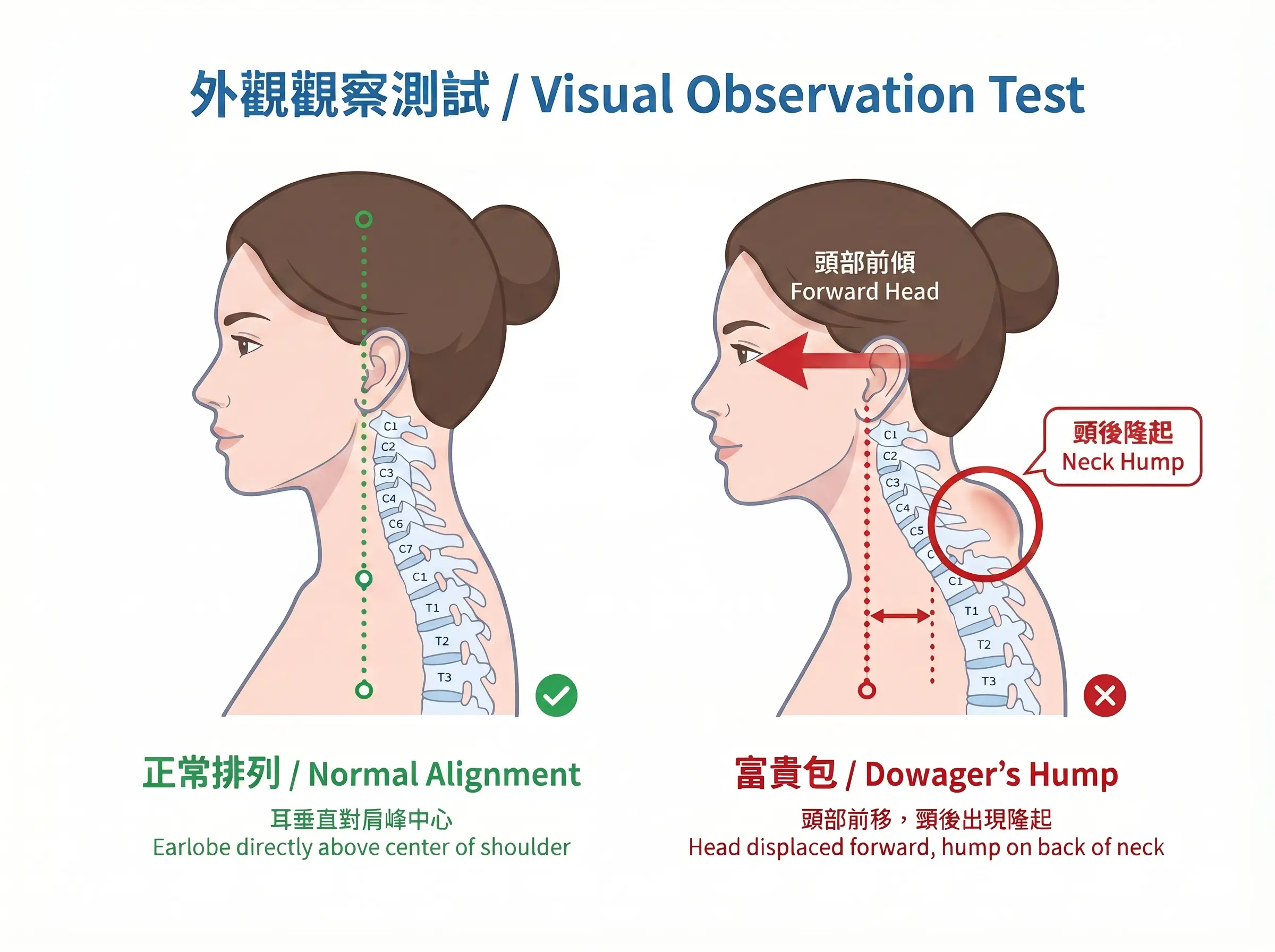
Visual Observation Test

  1. Visual: Have someone take a photo of your profile. Check if your earlobe aligns vertically with the center of your shoulder. If the earlobe is significantly forward and there is a visible curve, it is likely a Dowager’s Hump.
  2. Touch: While keeping your head neutral, feel the most prominent bone at the base of your neck (C7).

Result: If you feel a thick, firm “pad” of flesh around that bone that feels sore or stiff when pressed, it is likely a myofascial-type hump.

Physiotherapy Treatment Approach

The goal of physical therapy is to restore mobility, reduce pain, and fix the root postural issue.

  • Manual Therapy: Therapists use deep tissue massage and myofascial release to reduce adhesions and improve circulation. They may also perform joint mobilization on the cervical and thoracic spine to restore proper alignment and relieve nerve pressure.
  • Exercise Therapy (Rehabilitation): The most critical part of long-term recovery.
    • Stretching: Targeting tight chest muscles (pectorals) and anterior neck muscles to “open up” the chest.
    • Strengthening: Training deep cervical flexors to stabilize the neck and strengthening the middle/lower trapezius and rhomboids to pull the shoulder blades back.
    • Posture Training: Learning to maintain a neutral spine during daily activities.
  • Modalities (Equipment): * Ultrasound: Promotes deep tissue healing.
    • Interferential Therapy (IFT): Relaxes deep muscles and eases pain.
    • Shockwave Therapy: Breaks down stubborn fascial adhesions and chronic inflammation.
  • Acupuncture / Dry Needling: Targets “trigger points” (knots) in the muscles to instantly release tension and improve local microcirculation.

Frequently Asked Questions

This depends on the type. Myofascial or mild fatty types usually show significant improvement or complete flattening within 4 to 8 weeks of active therapy. If there is severe skeletal deformation, the goal shifts to pain management and preventing further worsening; the physical bulge may not disappear entirely.

Usually, a clinical assessment and palpation are enough. However, if you experience severe arm numbness, weakness, or suspected disc herniation, an X-ray or MRI may be recommended to rule out structural nerve compression.

This is a common misconception. Sleeping without a pillow leaves the neck unsupported, causing it to over-extend and increasing muscle strain. You should use a pillow that fills the gap behind your neck (when on your back) or matches your shoulder width (when on your side) to keep the spine neutral.

Prevention is key. Elevate your monitor to eye level to avoid looking down. Use a chair with good lumbar support. Most importantly, take a break every 45–60 minutes to perform chest stretches and neck retractions to break the cycle of static posture.

Many people confuse “Dowager’s Hump” with “Buffalo Hump” because both appear in the same area, but their causes and health risks are very different.

  • Dowager’s Hump (Kyphosis/Postural): Primarily caused by mechanical issues—long-term poor posture. It is often accompanied by muscle pain and stiffness. Physical therapy and posture correction are highly effective here.
  • Buffalo Hump (Dorsocervical Fat Pad): This is a red flag for endocrine or metabolic issues. It is typically caused by high levels of cortisol, often seen in Cushing’s Syndrome or long-term high-dose steroid use. It is purely a fat deposit and usually doesn’t come with muscle pain, but may be accompanied by a “moon face,” central obesity, and thinning skin. If a Buffalo Hump is suspected, you should see an endocrinologist rather than relying solely on physical therapy.

Testimonials & Reviews

As someone who regularly goes through the torment of backpain and neck pain, I was recommended by my friend to visit Mobilize Physiotherapy.

Everything -- from appointment booking to the physiotherapy session itself -- was very professional. Not only did Avery, my physiotherapist. give detailed explanations as he worked through my areas of pain, he taught me a few exercises that improve my core strength, which in turn could reduce my back and neck pain. Now, whenever I experience acute pain, I do these exercises and the pain eases away! I highly recommend Mobilize Physiotherapy.
William Luk
⭐ ⭐ ⭐ ⭐ ⭐
I had never been a believer in physio therapy in the past or that my experience with multiple chain medical physiotherapy center had brought me nothing but temporary improvements. Until I had came across mobilize physiotherapy where they take the extra mile to examine your situation and tailor a physiotherapy session. The physiotherapists at Mobilize not only identifies the root cause and provide massages for pain relievers but also to provide take home exercises for improvements. I was never rush out the door for the next session and they ensure that I had receive the right treatment before the session ends.
I would highly recommend this physiotherapy center.
Edmond Chan
⭐ ⭐ ⭐ ⭐ ⭐
Excellent service. The physiotherapists are very professional, easy to communicate with and also give clear instructions on some home exercises that can help ease my pain.

As a stay at home mom, I need a lot of strength on my daily routine and whenever I have any pain and problems I go to Avery for therapies and he is always helpful and caring Highly recommended!
Samantha Lee
⭐ ⭐ ⭐ ⭐ ⭐
Very professional therapy that doesn't only focus on passive treatment but also targets training of weak spots to improve overall performance and physiological sustainability.
Felix Lo
⭐ ⭐ ⭐ ⭐ ⭐
Will was very professional. He was very thorough with the assessment and suggested different exercises for me to improve my condition. Recommended 👍🏾
Keith So
⭐ ⭐ ⭐ ⭐ ⭐
Very caring and professional! Able to find out the root cause and provide effective treatment! Pain was much relieved! Highly Recommended!
Joanne Cheng
⭐ ⭐ ⭐ ⭐ ⭐

Book an Appointment

Get in touch with our physiotherapists