Common Conditions
Knee Pain
Knee Pain Treatment: From Self-Assessment to Physiotherapy
Knee Pain: Diagnosis to Recovery
Knee pain has many possible causes and is not always due to “degeneration.” At Mobilize Physio, we use clinical differential diagnosis to help identify the true source of your pain. Based on medical guidelines, this page explains how knee pain can be initially screened according to pain location and symptom patterns.
Is Knee Pain Always a Knee Problem? (Referred Pain)
Pain may originate from the lumbar spine or hip joint (referred pain). In some cases, the knee is only the “victim,” while the true source of the problem lies in the lower back or hip. This phenomenon is known as referred pain.
Lumbar Spine Nerve Compression: The nerves responsible for sensation in the lower limb originate from the lumbar spine, particularly the L3–L4 segments. If a disc herniation compresses these nerves, pain may travel like an electric shock from the thigh down to the knee. This type of pain is often accompanied by numbness or weakness in the leg.
Hip Joint Stiffness: The hip and knee joints are connected by the same femur. When hip mobility is restricted (for example, difficulty rotating the hip), the knee is forced to tolerate extra rotational stress during walking or sports, which can lead to pain.
Professional Tip: If your knee pain is accompanied by pain when bending forward, or if your hip feels “stuck” when putting on socks, it is recommended to assess the lumbar spine and hip joint first.
How to Initially Identify Knee Pain Based on Pain Location
Doctors and physiotherapists often use pain location as a key factor in preliminary differential diagnosis. You can compare your symptoms with the categories below:
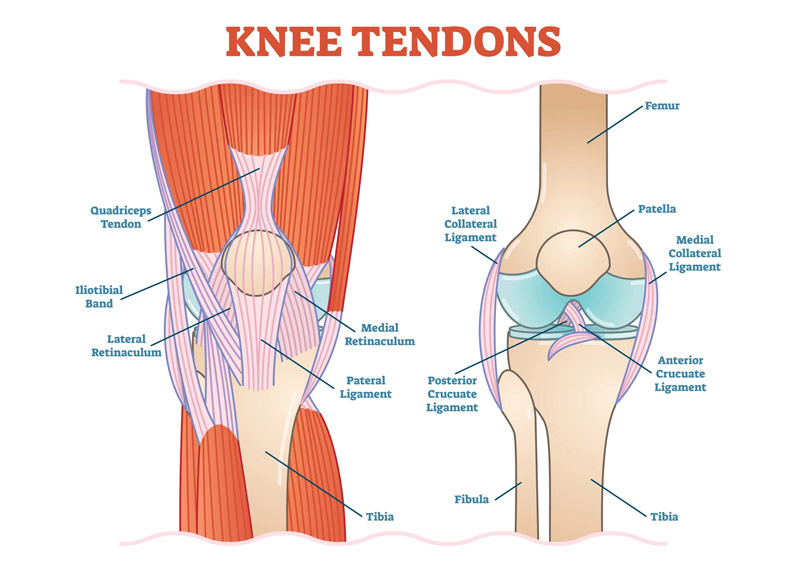
Front of the Knee (Anterior):
Sensation: Pain when going up or down stairs, or aching at the front of the knee after prolonged sitting.
Common Causes: Patellofemoral Pain Syndrome (PFPS), also known as Runner’s Knee, usually due to abnormal patellar tracking.
- Below the Kneecap (Inferior):
- Sensation: A sharp, pinpoint pain, most noticeable during jumping or deep squatting.
- Common Causes: Patellar Tendinitis (Jumper’s Knee).
- Outer Side of the Knee (Lateral):
- Sensation: A tight or stabbing pain on the outside of the knee after running for a period of time.
- Common Causes: Iliotibial Band (ITB) Syndrome.
- Inner Side / Joint Line (Medial / Joint Line):
- Sensation: Pain when pressing along the joint line, or a feeling that the knee is “catching” or “locking.”
- Common Causes: Meniscus Tear or Knee Osteoarthritis (OA).